
You are $125.00 away from Free Ground Shipping

Pinoy Angelfish

1 review

Price range: $24.00 through $29.00

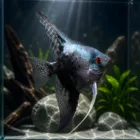
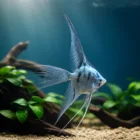
Pinoy Angelfish display a striking dark body with a beautiful blue overtone created by a double dose of the Philippine Blue gene. Colors intensify with age, with mature adults showing the most vivid blue shading over their dark bodies.

Description

A Dark Beauty That Improves With Age

Our Pinoy Angelfish are a stunning dark variety carrying a double dose of the Philippine Blue gene combined with at least one copy of the Dark gene, creating a rich black body with a captivating blue overtone that sets them apart from standard dark angelfish. Young fish often appear predominantly black, but as they mature the blue tones begin to emerge and intensify, with fully mature adults displaying the most vivid and saturated blue coloring over their dark bodies. The older they get, the more breathtaking they become.

Genetics Pinoy Angelfish carry a double dose of the Philippine Blue gene combined with at least one Dark gene, expressed as D/+ pb/pb or D/D pb/pb. The interaction between these genes creates the characteristic dark body with blue overtones that define the Pinoy phenotype. Available in Standard and Veil fin options.
Angelfish Care Guide and Other Information

Scientific NamePterophyllum scalare
TemperamentSemi-Aggressive. Angelfish can make good community fish; however, due to their semi-aggressive nature, they need to be closely monitored...and deal with if they become too aggressive. For this reason we do not recommend angelfish for beginners.
Lifespan10-15 years with proper care.
Adult SizeThe central body will reach a large dollar coin, approx 3-4 inches in diameter, excluding the fins. Depending on the fin type on how big their overall size can become. Also, angelfish will continue to slowly grow and bulk up as they age.
General Hardness8 dGH or 100 TDS. Angelfish do best in soft water, but can easily adapt to hard water. If mineralization is too high eggs may not hatch. When this happens may need to consider alternate methods if wanting to breed.
Tank Size20 Gallon High for the first angelfish; and an additional 10 gallons for each additional angel.
Group SizeAngelfish can be kept in singles or in groups. While juveniles, they do best in groups. But once they mature, they may begin to fight for territory and for their mate. To minimize squabbles, do not house 3 together as the dominant two will pick on and potentially kill the submissive one.
HabitatFreshwater
Dietary NeedsOmnivore. Angelfish need extra protein and plant sources for optimum health. Options include:
  • Gourmet Cichlid Flake or Tropical Color Flake
  • Artemia Flake - especially when raising red or deep orange varieties
  • Newly hatched Baby Brine Shrimp Eggs (BBS)
  • Golden Pearls - great alternative to hatching BBS. A great alternative to hatching BBS.
  • Sticks - any flavor. Popular options include Beefheart Sticks, Bloodworm Sticks, Silkworm Sticks, Spirulina Sticks, Very Veggie Sticks, and much more.
  • Organic Granules
  • Repashy
  • Even fresh veggies and occasional fruits. But be aware, fresh foods can quickly pollute the tank. I like to use fresh foods 1-2 days before doing water changes or maintenance to clean up
BreedingAngels can learn to parent raise their offspring if housed in their own tank 29 gallons or larger; or can pull the eggs and hatch artificially.

Our tank parameters fish are born and raised in

Temperature78-80F
TDS80-100
pH7.4 - 7.6
NitratesLess than 20ppm

1 review for Pinoy Angelfish

4.0
Based on 1 review
5 star
0%
4 star
100
100%
3 star
0%
2 star
0%
1 star
0%
  1. DEBBIE (Verified)

    These are really nice fish, but the fins weren’t as long as I thought they would be. Maybe as they age, they will get longer.

    (0) (0)
Add a review

Q & A

Ask a question
You must be logged in to ask a question Log In
There are no questions yet